Training a quantum optimizer
In this paper, published in Physical Review A, we show how to greatly improve success at solving Constraint Satisfaction Problems on a quantum computer by using a learned schedule, instead of the standard linear ramps.
 Azure
Azure
In this paper, published in Physical Review A, we show how to greatly improve success at solving Constraint Satisfaction Problems on a quantum computer by using a learned schedule, instead of the standard linear ramps.

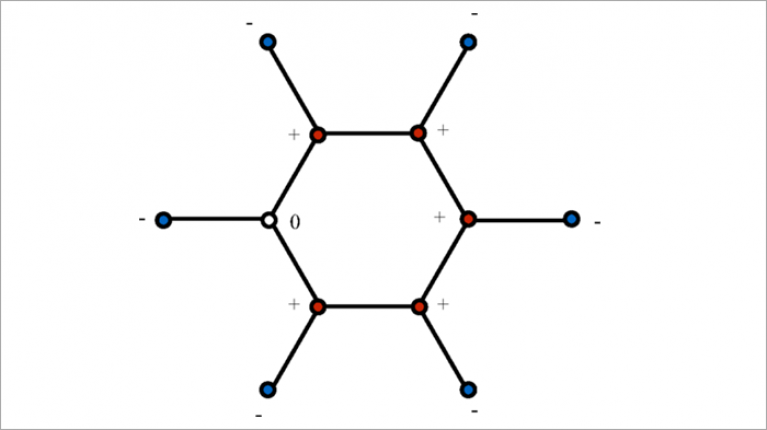
Topological materials can yield quasiparticles that behave in a manner similar to elementary particles that are part of the standard model of particle physics. In this paper, published in Physical Review X, we report on a new class of such quasiparticles—triple point fermions—which represent fermions that have mixed properties of Dirac and Weyl fermions.
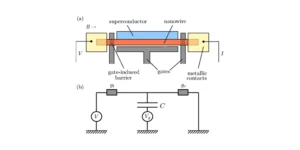
In this paper, which was just published in Physical Review B, a quantitative theory for the two-terminal conductance of a proximitized nanowire in the Coulomb blockade regime is developed.

LIQUi|> is a software architecture and tool suite for quantum computing. It includes a programming language, optimization and scheduling algorithms, and quantum simulators. LIQUi|> can be used to translate a quantum algorithm written in the form of a high-level program into the low-level machine instructions for a quantum device.

In an external magnetic field, the energy of an electron in a two-dimensional system takes discrete values, called Landau levels. At high enough fields, all electrons in a solid can fit in the lowest Landau level.
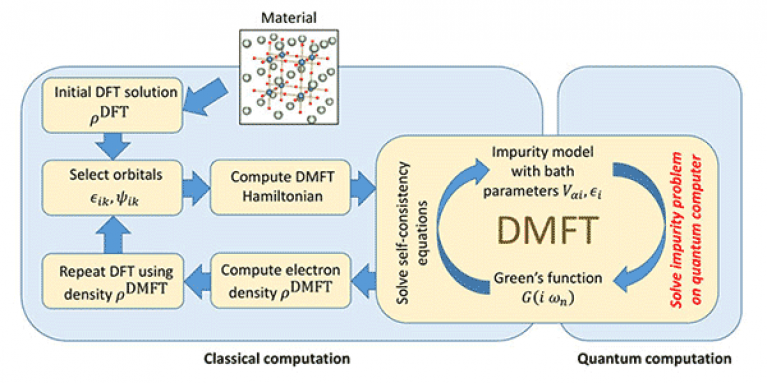
Recent improvements in the control of quantum systems make it seem feasible to finally build a quantum computer within a decade.

Quantum information theory has the potential to revolutionize computation, cryptography, and simulation of quantum systems. However, quantum states are fragile, and unwanted interactions with the environment destroy the information before it can be manipulated successfully.